
How Workplace Noise Is Measured
Reliable workplace noise measurement combines calibrated instruments, representative work conditions, task observations and professional interpretation. This guide explains the main methods, what they do and do not show, and why a single decibel reading rarely characterises real exposure.
Category
Exposure & measurement
Audience
Employers & SHEQ teams
Scope
UK occupational noise
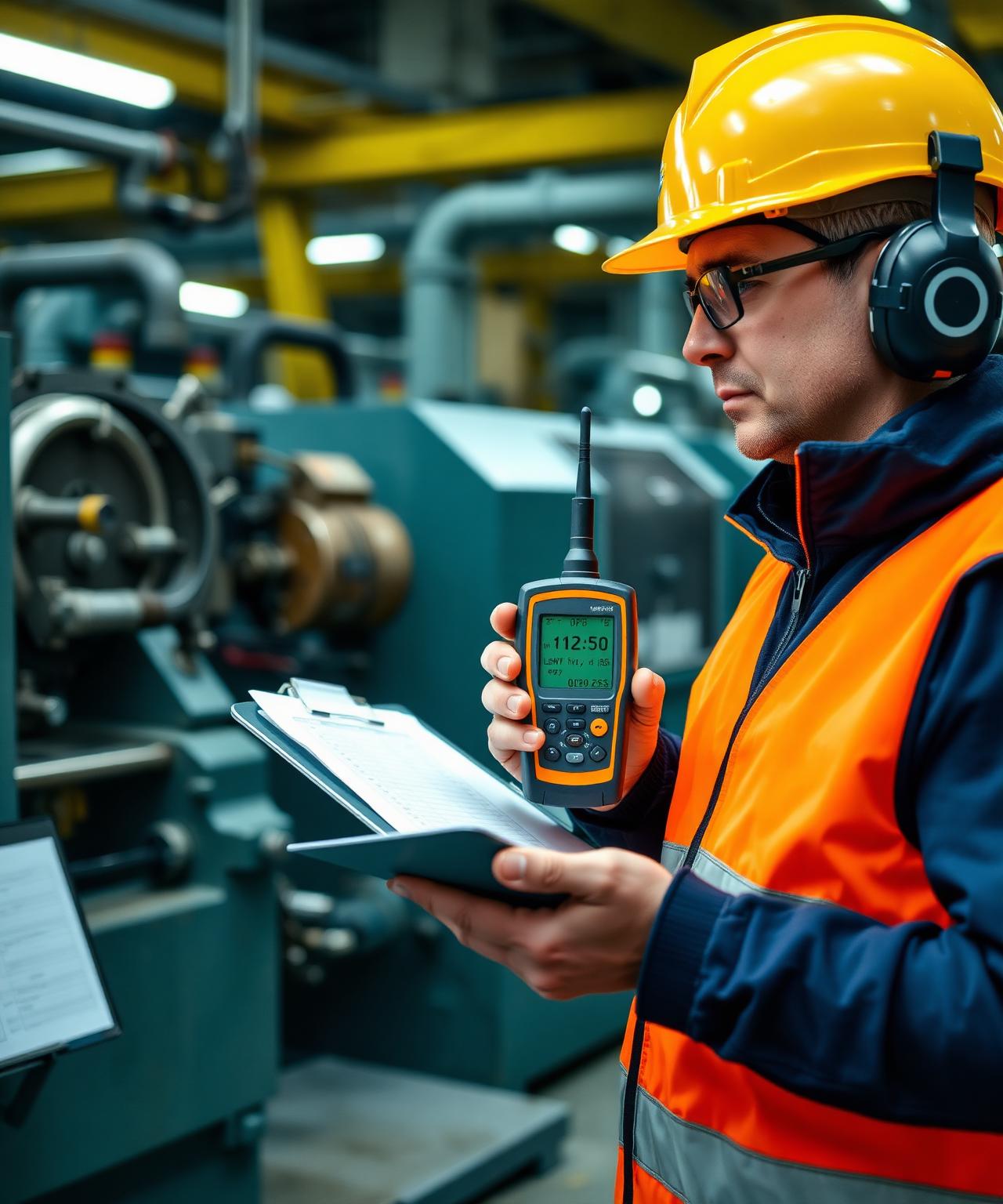
Calibrated workplace measurement
Area · task · personal · peak
Quick summary
- Calibrated sound-level meters measure areas, tasks and machinery.
- Personal dosimeters follow workers through changing activities.
- Both noise level and duration matter for exposure.
- Peak noise is assessed separately from average exposure.
- Measurements must represent normal work conditions.
- One spot reading rarely provides a complete exposure assessment.
Why measure
Why workplace noise is measured
Workplace noise measurement is the evidence base for decisions on exposure, controls and hearing protection. Reliable data supports:
- Identifying noisy tasks and noise sources.
- Evaluating employee noise exposure.
- Comparing findings with UK exposure action values.
- Prioritising engineering and organisational controls.
- Reviewing hearing protection selection and use.
- Planning further or follow-up monitoring.
- Documenting workplace conditions for the assessment record.
- Reviewing changes in machinery, production or layout.
More than a number
Measurement is more than a decibel reading
A single instantaneous reading describes one moment at one point. Workplace exposure depends on level and duration, and on the way work actually unfolds. Reliable measurement has to consider:
- Duration of exposure across the working day.
- Worker movement between areas and tasks.
- Changing tasks with different noise profiles.
- Machinery cycles and operating states.
- Several sources operating at the same time.
- Quiet periods and breaks within the shift.
- Brief peak or impact noise events.
- How representative the measurement conditions are.
Measurements should be connected to the actual workplace activities that produced them, not interpreted in isolation.
Initial review
Initial workplace review
Effective measurement begins before any instrument is turned on. An initial review establishes what should be measured, how and when:
- 1Consultation with site management and workers.
- 2Workplace walkthrough of relevant areas.
- 3Machinery and process review.
- 4Task identification and grouping.
- 5Shift patterns and rotation.
- 6Worker roles and movement.
- 7Maintenance and cleaning activities.
- 8Existing engineering and organisational controls.
- 9Hearing protection currently in use.
- 10Previous noise reports and complaints.
- 11Known high-noise areas and machinery.
Methods
Main workplace noise measurement methods
Different methods answer different questions. The right combination depends on the assessment objective and the way the work is performed.
Area measurements
Sound levels recorded at fixed locations to characterise zones, access routes and operator positions.
Task-based measurements
Sound levels recorded during defined activities so each task's contribution to exposure can be quantified.
Operator-position measurements
Measurements taken at the worker's normal position, posture and distance from the source.
Machinery-source measurements
Targeted measurements around individual machines under representative operating conditions.
Personal noise dosimetry
Body-worn instruments capturing changing exposure as workers move through tasks and locations.
Full-shift monitoring
Monitoring across a representative shift to reflect breaks, transitions and variability.
Peak-noise assessment
Separate assessment of impulsive or impact noise as C-weighted peak sound pressure (LCpeak).
Workplace noise mapping
Multiple measurement points used to visualise the spatial distribution of noise across an area.
Sound-level meters
Sound-level meters
An integrating sound-level meter measures varying sound over a defined period and reports averaged and instantaneous values. For occupational noise work, it provides A-weighted levels for general exposure assessment and, where supported, C-weighted peak sound pressure (LCpeak) for impulsive noise.
Time weighting, averaging and data-logging options determine how the instrument responds to changing sound and what data is stored for later analysis. Configuration matters: the same instrument used in different settings can produce values that cannot be directly compared.
The choice of meter, settings and microphone position should match the assessment objective and the type of noise being measured. Instrument detail belongs in the assessment record rather than on the workshop floor.
Personal dosimeters
Personal noise dosimeters
A personal noise dosimeter is a small wearable instrument with its microphone positioned near the hearing zone. It records sound at the worker over time, capturing changing exposure as tasks, locations and activities change through the shift.
Dosimetry is particularly useful for mobile and multi-task workers, where fixed-position measurements cannot reasonably represent personal exposure. It can be used for full-shift or task-based monitoring and produces cumulative exposure data that must be interpreted alongside an activity log.
For the method itself — microphone placement, full-shift versus task-based monitoring and common limitations — see what is personal noise dosimetry. The commercial service is described on the personal noise dosimetry page.
Calibration checks
Acoustic calibrators and measurement checks
An acoustic calibrator applies a known reference sound to the instrument microphone so that the instrument’s response can be checked before and after measurement. Pre-use checks confirm the instrument is reading correctly at the start of work; post-use checks confirm it has not drifted during the session.
Calibration check results are recorded and used to validate the data. A field calibration check is not a substitute for formal periodic instrument calibration, which is carried out against traceable standards on the schedule defined for the instrument.
Area measurements
Area noise measurements
Area measurements record sound at fixed locations within the workplace — work areas, access routes, operator zones, background positions and known higher-noise locations. They characterise the spatial distribution of noise and support workplace noise mapping.
Area measurements describe the level at a position, not the exposure of a worker. They are useful for identifying zones and prioritising controls, but they do not automatically equal personal exposure, particularly where workers move or tasks vary.
Task-based measurements
Task-based measurements
Task-based measurements quantify sound during defined activities — for example machinery operation, cutting, grinding, loading, maintenance, cleaning or specific production cycles. Combined with the duration of each task, they show how individual activities contribute to daily exposure.
Task-based data is particularly valuable for identifying dominant tasks and for building exposure estimates for groups of workers whose work is composed of identifiable, repeatable activities.
Operator position
Operator-position measurements
Operator-position measurements are taken close to the worker’s normal working position, reflecting typical posture, distance to controls and orientation toward the noise source. Where guarding, enclosure or worker movement changes the sound at the ear, the position used should reflect actual practice.
Position, activity and operating conditions should always be documented so the result can be interpreted with the correct context.
Machinery sources
Machinery-source measurements
Machinery-source measurements characterise individual machines under representative operating conditions — measurement distance, operating state, machine cycle, load, guarding, enclosure and maintenance condition all affect the result. Several machines operating together typically produce higher combined levels than any single source measured in isolation.
Source measurements support control prioritisation but should not be confused with employee exposure. They describe the machine, not the person.
Full-shift monitoring
Full-shift monitoring
Full-shift monitoring covers a representative working period from start to finish. It is particularly useful for mobile work, changing tasks, several locations, breaks and abnormal events. The aim is to capture the way exposure accumulates across the day rather than at one point in time.
A single full shift does not automatically represent all shifts. Where production, staffing or task mix vary materially between shifts, additional monitoring across those shifts is needed.
Peak noise
Peak noise measurements
Peak noise is reported as C-weighted peak sound pressure (LCpeak). It typically arises from impulsive or impact noise — hammering, pressing, metal impact, pneumatic equipment, cartridge tools where used, and loading impacts. Capable sound-level meters and dosimeters can record peak events alongside average exposure.
Peak measurements are assessed separately from daily average exposure because they describe a different risk: brief high-level events that can damage hearing even when the average exposure is moderate.
dB(A)
Understanding dB(A)
dB(A) describes a sound level measured with A-weighting, a frequency response that broadly reflects the relative sensitivity of human hearing at moderate levels. A-weighted levels are the standard metric for general occupational noise exposure.
The decibel is a logarithmic scale, so modest numerical increases can represent substantial changes in sound energy. A change of a few dB(A) is rarely “small” in practical terms.
dB(C)
Understanding dB(C)
dB(C) describes a sound level measured with C-weighting, which gives more weight to low-frequency content than A-weighting. C-weighting is used principally for peak sound pressure assessment and where low-frequency components matter.
dB(A) and dB(C) are not interchangeable. Which metric matters depends on the assessment purpose: average daily exposure is reported in dB(A), while peak events are reported as LCpeak in dB(C).
Equivalent continuous level
Equivalent continuous sound level
The equivalent continuous sound level represents the constant sound level that would carry the same sound energy as the varying actual sound over the measurement period. It is useful for characterising changing machinery, cyclic processes and tasks where the level varies through the measurement.
It is not the same as a simple arithmetic average of individual readings, because the underlying scale is logarithmic. The length and representativeness of the measurement period determine how usefully the resulting value characterises the work.
LEX,8h
Daily personal exposure and LEX,8h
LEX,8h is the daily personal noise exposure level expressed in dB(A), normalised to a notional eight-hour working day. It combines the equivalent continuous sound level of each activity with its duration, producing a single figure that can be compared with the UK exposure action and limit values.
LEX,8h is not the same as a live meter reading. Shifts that are materially shorter or longer than eight hours need careful interpretation, and the underlying measurements must be representative of normal work. For action-value interpretation, see understanding noise action values. For the commercial assessment service, see noise exposure assessment.
Representative conditions
Representative measurement conditions
Measurements should reflect the way the workplace normally operates. Where conditions are unusually quiet or busy, the departure should be documented and considered in the interpretation.
- Normal production rates and product mix.
- Typical machinery load and operating state.
- Normal staffing levels and shift patterns.
- Representative tasks across the working day.
- Usual work pace and operating procedures.
- Maintenance and cleaning activities where relevant.
- Seasonal or batch differences where they matter.
- Documented departures from normal conditions.
Duration
Measurement duration
Measurement duration depends on the task. Stable, repeatable noise can often be characterised in a short period, while short machine cycles need enough captures to be representative, long production cycles need coverage of the full cycle, and intermittent work needs sampling that reflects the timing of the activity.
Full-shift monitoring is used where shorter samples cannot reasonably represent exposure. There is no single universal measurement duration — the period should be long enough to capture representative variation in the work.
Worker selection
Selecting workers and similar exposure groups
Workers are normally grouped into similar exposure groups based on comparable tasks, locations and shift patterns. Representative individuals are selected from each group, and additional workers are monitored where variability or uncertainty is high.
- Representative workers across each role.
- Similar exposure groups based on comparable tasks.
- Workers with comparable work patterns and locations.
- Coverage of shift variation where it is material.
- Inclusion of mobile and multi-task roles.
- Sample size appropriate to the uncertainty involved.
- Additional workers where variability is high.
Noise mapping
Workplace noise mapping
Workplace noise mapping combines measurements at multiple locations to visualise the spatial distribution of sound across an area. It supports identification of higher-noise zones, hearing protection zones, machinery contributions and control priorities, and helps communicate noise risk to workers and visitors.
A noise map characterises area noise. It does not replace personal exposure assessment, and should be interpreted alongside task and personal measurements where workers move through the mapped space.
Shift variation
Measurements during different shifts
Day, evening and night shifts can present materially different exposure. Production differences, staffing variation, cleaning, maintenance, start-up and shutdown, and peak demand can all change the work and the noise it produces. A single shift may not represent another.
Where shift differences are significant, measurements should be carried out across the relevant shifts and the results interpreted together so the assessment scope is clear about which shifts the conclusions apply to.
Variable noise
Measuring variable and intermittent noise
Real workplaces rarely produce steady sound. Changing machinery states, irregular impacts, temporary activities, maintenance, alarms, loading and worker movement all introduce variation into the measurement. Capturing that variation requires observation alongside the recorded data.
Activity records support the interpretation by linking peaks and changes in the time-history to specific activities and events. Without that context, isolated numbers can be hard to attribute and easy to misread.
Activity records
Recording workplace activities
Reliable interpretation depends on knowing what was happening during the measurement. Typical records include:
- Task start and finish times.
- Machinery and tools in use.
- Worker position and distance from sources.
- Operating settings and machine state.
- Hearing protection in use and removal periods.
- Breaks, meetings and rest periods.
- Unusual events and temporary noise sources.
- Comments from workers and supervisors.
- Observer notes and timed observations.
Uncertainty
Measurement uncertainty
Every measurement carries uncertainty. A defensible report acknowledges where that uncertainty comes from:
- Instrument accuracy and class.
- Sampling variation across time and location.
- Variation in work patterns between days.
- Microphone position relative to the source.
- Environmental conditions where relevant.
- Incomplete or imprecise task information.
- Limited monitoring periods.
- Professional judgement in interpretation.
Common errors
Common measurement errors
- Using a phone app as the main assessment.
- Measuring during an unrepresentative quiet period.
- Relying on a single spot reading.
- Ignoring task duration when interpreting levels.
- Poor microphone position or obstruction.
- Not carrying out calibration checks.
- Ignoring peak or impulsive noise.
- Failing to record work activities.
- Treating area noise as personal exposure.
- Monitoring the wrong worker for the question asked.
- Not considering multiple shifts.
- Interpreting numbers without workplace context.
Phone apps and low-cost meters
Phone apps and low-cost meters
Phone apps and inexpensive meters can have screening value for raising awareness. They are not, however, a substitute for suitable professional instruments. Microphone quality, unknown calibration, device-to-device variation and configuration limitations mean their values cannot reliably be compared with action and limit values.
Formal exposure assessment, action-value comparison and hearing-protection decisions should not be based on phone-app readings. Where exposure matters, suitable instruments used by a competent person are the right starting point.
Interpretation
How measurement results are interpreted
Interpretation combines the recorded data with the activity log, the workplace observations and an understanding of how the work normally runs. Task contributions are reviewed, daily and weekly exposure are calculated, peak findings are considered separately and the results are compared against the relevant action and limit values.
Controls are then prioritised and hearing protection reviewed in the light of the data. Uncertainty and limitations should be acknowledged so that recommendations are made with the data’s reliability in mind.
Reporting
What a workplace noise report may include
- Scope and assessment objective.
- Workplace description and processes.
- Instruments used and configuration.
- Calibration checks before and after measurement.
- Measurement locations and tasks covered.
- Workers monitored and similar exposure groups.
- Results and time-history overview.
- Daily and weekly exposure interpretation.
- Peak sound pressure findings.
- Comparison with UK action and limit values.
- Limitations on the data and assessment.
- Recommended controls and priorities.
- Hearing protection review and recommendations.
- Review and reassessment requirements.
Supporting noise control
How measurements support noise control
Good measurement data is the foundation for practical noise control. Typical areas where measurement supports decisions:
- Source identification and ranking.
- Enclosure, isolation and damping options.
- Silencers and acoustic absorption.
- Maintenance and condition improvements.
- Layout changes and source separation.
- Selection of quieter equipment.
- Reduced exposure duration where practicable.
- Hearing protection selection and review.
- Verification of controls after implementation.
How we help
How Workplace Noise Surveys can help
Site-specific support across the workplace noise programme:
Workplace noise monitoring
Representative occupational noise measurement across operations, tasks and workers.
Visit pageWorkplace noise surveys
Site-wide surveys interpreting area, task and personal exposure data.
Visit pageNoise exposure assessment
Daily and weekly LEX,8h calculation and interpretation against UK action values.
Visit pagePersonal noise dosimetry
Full-shift and task-based dosimetry for mobile, multi-task and variable-exposure roles.
Visit pageFactory noise surveys
Production-line, machinery and process noise assessment for manufacturing.
Visit pageWorkplace acoustic surveys
Reverberation, sound distribution and acoustic-control assessment.
Visit pageHearing protection assessment
Hearing protection selection, attenuation, fit and review.
Visit pageOccupational hygiene noise services
Integrated occupational hygiene support across dosimetry, survey and control review.
Visit pageRelated guidance and services
Related guidance and services
Workplace Noise Resources
UK workplace noise knowledge centre and category index.
Read moreWhat Is Personal Noise Dosimetry?
How personal noise dosimetry works and when it is appropriate.
Read moreUnderstanding Noise Action Values
The 80, 85 and 87 dB(A) action and limit values explained.
Read moreNoise at Work Regulations Explained
Practical walk-through of the Control of Noise at Work Regulations 2005.
Read moreWorkplace Noise Monitoring
Representative occupational noise measurement across operations.
Read moreWorkplace Noise Surveys
Site-wide workplace noise survey scope and methodology.
Read moreNoise Exposure Assessment
LEX,8h calculation and action-value interpretation.
Read morePersonal Noise Dosimetry
Commercial dosimetry service for mobile and variable-exposure roles.
Read moreFactory Noise Surveys
Production-line, machinery and manufacturing noise assessment.
Read moreWorkplace Acoustic Surveys
Reverberation, sound distribution and acoustic-control assessment.
Read moreOccupational Hygiene Noise Services
Occupational hygiene support across the noise programme.
Read moreArticle disclaimer
This article provides general guidance on occupational noise measurement in UK workplaces. It is not legal advice. The appropriate measurement strategy depends on the actual work, tasks and exposure at a specific workplace, and competent assessment may be required to meet duties under the Control of Noise at Work Regulations 2005.
Frequently asked questions
Frequently asked questions
How is workplace noise measured?
Workplace noise is measured using calibrated instruments that record sound pressure level over time at representative work positions and on representative workers. Measurements are interpreted alongside observations of tasks, machinery, durations and shift patterns so that exposure can be linked back to the work that produced it. Reliable measurement combines area, task and personal methods, not a single reading.
What equipment is used to measure workplace noise?
Typical equipment includes integrating sound-level meters for area, task and operator-position measurements, personal noise dosimeters worn by sampled workers, and an acoustic calibrator used to check the instrument before and after measurement. The combination depends on the assessment objective and the way the work is performed.
What is a sound-level meter?
A sound-level meter is a calibrated instrument that records sound pressure level. An integrating-averaging meter is normally used for occupational noise work because it can capture varying sound over a defined period and report equivalent continuous level (LAeq) and, where supported, C-weighted peak sound pressure (LCpeak) alongside instantaneous values.
What is a personal noise dosimeter?
A personal noise dosimeter is a small body-worn instrument that records sound near the worker's hearing zone over time. It follows the worker through changing tasks, locations and activities and is particularly useful where area measurement alone cannot reasonably represent personal exposure.
Is one decibel reading enough?
No. Workplace noise varies with tasks, machinery cycles and time, and a single instantaneous reading rarely characterises exposure. Representative measurement requires enough time and the right combination of methods to capture how level and duration combine over a working day.
What is the difference between area and personal noise measurements?
Area measurements describe sound at a fixed location and are useful for characterising work zones, access routes and operator positions. Personal measurements describe the exposure of a specific worker as they move and change tasks. Area readings do not automatically equal personal exposure; the two methods answer different questions and are often used together.
How long should workplace noise be measured?
Measurement duration depends on the task. Stable, repeatable noise can often be characterised in a short period, while variable, intermittent or cyclic work needs longer monitoring to capture representative variation. Full-shift dosimetry is used where work patterns make shorter samples unrepresentative. There is no single universal duration.
What does dB(A) mean?
dB(A) refers to a sound level measured with A-weighting, a frequency response that broadly reflects the relative sensitivity of human hearing at moderate levels. A-weighted levels are used for most occupational exposure assessments. Because the decibel is a logarithmic scale, modest numerical increases can represent substantial changes in sound energy.
What does dB(C) mean?
dB(C) refers to a sound level measured with C-weighting, a frequency response that gives more weight to low-frequency content than A-weighting and is used for peak sound pressure assessment. dB(A) and dB(C) are not interchangeable; which one matters depends on the assessment purpose, with peak exposure normally reported as LCpeak in dB(C).
How is peak noise measured?
Peak noise is measured as C-weighted peak sound pressure (LCpeak) using a capable sound-level meter or dosimeter configured to capture impulsive events. Peak exposure is assessed separately from average exposure because brief impulsive sound from impact tools, presses or pneumatic equipment can present a hearing risk even when the daily average is moderate.
What does LEX,8h mean?
LEX,8h is the daily personal noise exposure level expressed in dB(A), normalised to a notional eight-hour working day. It combines the equivalent continuous sound level of each activity with its duration so that exposures can be compared against the UK action and limit values. LEX,8h is not the same as a live sound-level meter reading.
Can a phone app be used for workplace noise measurement?
Phone apps and low-cost meters may have screening value for awareness, but their microphone quality, calibration, configuration and device variation make them unsuitable for formal occupational exposure assessment. UK noise risk decisions and action-value comparisons should be based on suitable professional instruments used by a competent person.
What is workplace noise mapping?
Workplace noise mapping uses measurements at multiple locations to visualise the spatial distribution of noise across an area. It helps identify higher-noise zones, hearing protection zones, machinery contributions and control priorities, and supports communication with workers and visitors. A noise map characterises area noise; it does not replace personal exposure assessment.
Do different shifts need separate measurements?
Often, yes. Day, evening and night shifts can present materially different exposure because production rates, staffing, maintenance, cleaning and start-up activities vary. Where shift differences are significant, measurements should be carried out across the relevant shifts and the results interpreted together so the assessment reflects the full range of work patterns.
Site-specific support
Need Professional Workplace Noise Measurements?
Independent UK occupational noise specialists. Workplace noise measurements, exposure assessment, personal dosimetry and practical control recommendations — arranged around your operation.