
What Is Personal Noise Dosimetry?
Personal noise dosimetry measures a worker’s changing noise exposure across the working day, while they perform representative tasks in the actual workplace. This guide explains what the method is, how it works, when it is the right tool — and the limitations that any defensible interpretation has to take into account.
Category
Personal dosimetry
Audience
Employers & SHEQ teams
Scope
UK occupational noise
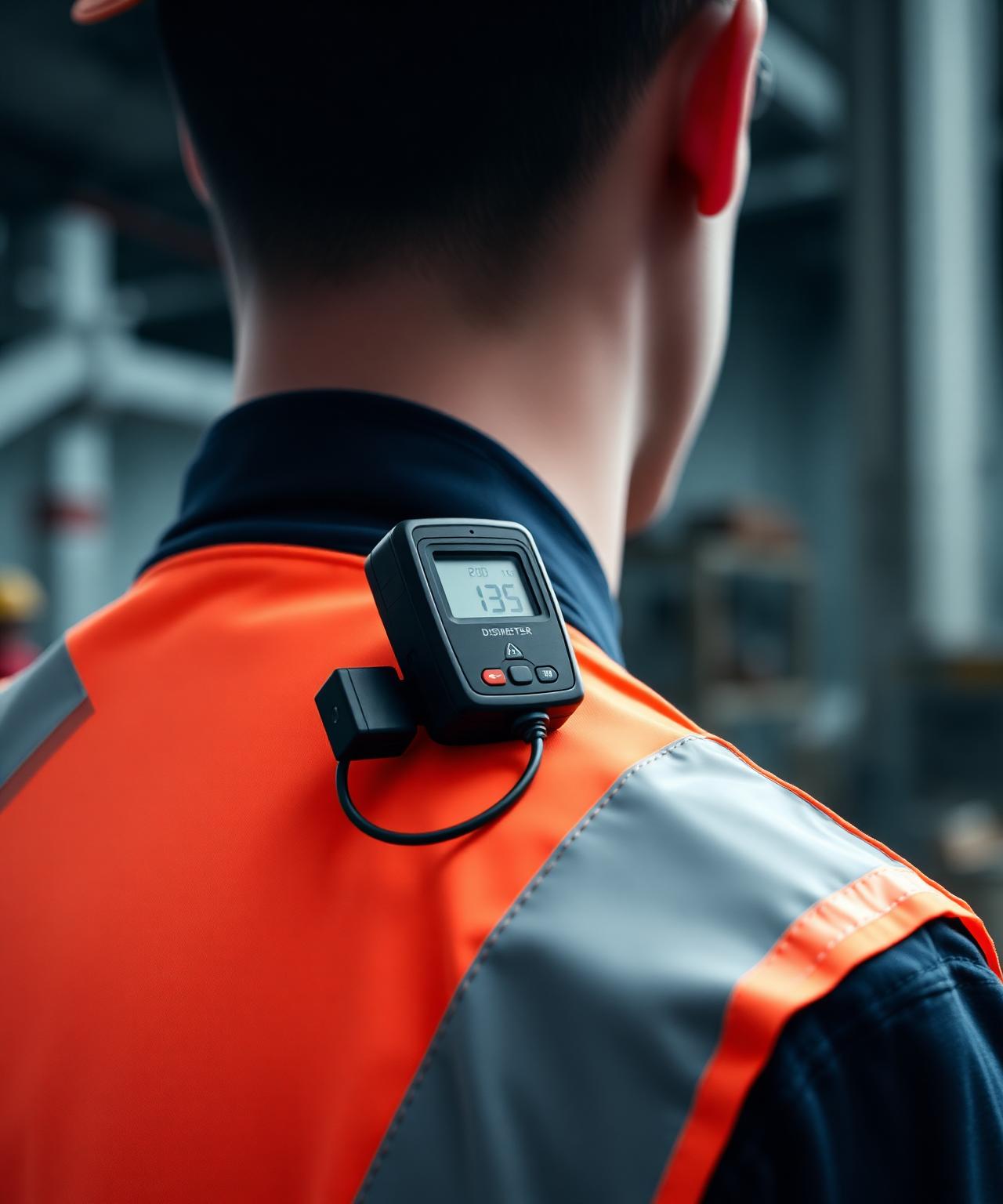
Body-worn personal dosimetry
Microphone at the hearing zone · full-shift exposure
Quick summary
- A dosimeter is worn by the worker during normal work.
- The microphone is positioned near the hearing zone.
- The device records changing exposure over time.
- Activity records are essential to interpret the data.
- Dosimetry is particularly useful for mobile or multi-task workers.
- It is not required for every noise assessment.
What it is
What is personal noise dosimetry?
Personal noise dosimetry is a structured method of measuring occupational noise exposure at the individual worker. A small body-worn instrument — the dosimeter — records sound near the hearing zone over time, as the wearer carries out normal tasks. The result is a record of exposure that follows the person, rather than a single fixed measurement at one position.
Unlike a handheld sound-level measurement, which describes the level at a chosen point at a chosen moment, dosimetry captures the way exposure changes through a representative shift. That makes it especially valuable where work patterns vary, where workers move between areas, or where tasks combine in ways that cannot be reconstructed from spot readings alone.
Dosimetry supports occupational noise exposure assessment by providing time-resolved data that can be interpreted against the UK exposure action and limit values. The data on its own is not the assessment; it must be reviewed alongside activity records and an understanding of the work performed.
The instrument
What does a personal noise dosimeter look like?
Although designs vary, a typical personal noise dosimeter is a small body-worn instrument that combines a microphone, a processing unit and internal data storage. The microphone may be on a short cable or integrated with the main body so it can be positioned near the worker’s ear or shoulder.
The instrument is normally attached securely to clothing, high-visibility vests or appropriate PPE so it stays in place throughout the shift. Some instruments include a display showing current exposure or accumulated dose; others are blind, with data downloaded afterwards. The specific configuration depends on the model and the measurement objective.
Method
How does personal noise dosimetry work?
The process below is a generalised overview of how a competent monitoring exercise is run. Specific steps depend on the instrument used and the assessment objective.
- 1Instrument configuration for the assessment objective.
- 2Fitting the dosimeter securely to the worker.
- 3Positioning the microphone near the hearing zone.
- 4Pre-use acoustic calibration with a recognised calibrator.
- 5Monitoring during representative work and tasks.
- 6Cumulative exposure recording across the period.
- 7Activity observations and a written activity log.
- 8Post-use calibration check after the measurement.
- 9Data download and time-history review.
- 10Validation against activity records and any abnormal events.
- 11Interpretation of exposure against UK action and limit values.
Microphone placement
Where is the microphone positioned?
The microphone is positioned near the worker’s hearing zone, usually on the shoulder or upper torso, so that the sound it records is broadly representative of the level at the ear during work. Placement should avoid obstruction by collars, hoods, hair or PPE, and the microphone should not rub against clothing.
Compatibility with the worker’s normal PPE matters — hard hat, hi-vis vest, respirator and ear defenders should still be worn as usual. Secure attachment and consistency of placement across workers and shifts help make results comparable. The exact position varies with instrument and task and should follow the manufacturer’s instructions and recognised measurement guidance such as BS EN ISO 9612.
Measurements
What does a dosimeter measure?
Depending on configuration, a personal noise dosimeter can record sound level over time, equivalent continuous sound level (LAeq), cumulative noise dose, projected dose and LEX,8h or equivalent exposure metrics. Many instruments also record maximum levels and C-weighted peak sound pressure (LCpeak) where supported.
The available outputs depend on the instrument and on the settings used at configuration. Reported values should always be considered alongside the criterion level, exchange rate and threshold that were applied.
When useful
When is personal dosimetry useful?
- Workers moving between areas during the shift.
- Changing tasks with different noise profiles.
- Intermittent noisy work.
- Maintenance, repair and engineering activities.
- Mobile technicians and field-based roles.
- Construction work across changing site conditions.
- Warehouse, logistics and materials-handling roles.
- Operations involving several machinery sources.
- Variable production rates or product mix.
- Uncertain full-shift exposure.
- Complex work patterns across the day.
- Limited representativeness of fixed-location readings alone.
When other methods may suffice
When may personal dosimetry not be necessary?
Dosimetry is not the default measurement for every workplace. Where the conditions below are met, task-based or area measurements may produce equally defensible exposure data.
- Stable, fixed work location across the shift.
- A single repetitive task.
- A consistent sound level over time.
- Known and reliable task durations.
- A straightforward exposure pattern.
- Existing representative task or area measurements.
The monitoring method should match the assessment objective and the way the work is actually performed.
Monitoring approaches
Full-shift and task-based dosimetry
Full-shift dosimetry
Across most or all of a representative shift
- Captures movement and task changes through the day.
- Reflects breaks and quieter periods.
- A single shift may not represent all shifts.
- Abnormal events can distort the result.
Task-based dosimetry
A defined activity over a shorter period
- Identifies the contribution of specific tasks.
- Supports exposure modelling for similar groups.
- Task results alone may not represent full-shift exposure.
- Task durations must be reliable.
Comparison
Dosimetry versus handheld measurements
Personal dosimetry
- Follows the worker.
- Captures changing exposure over time.
- Suited to mobile and multi-task roles.
- Needs activity records for interpretation.
Handheld measurements
- Assess areas, machines or tasks directly.
- Allow direct observation of sources.
- Often suit stable work patterns.
- May not represent personal exposure on their own.
A well-designed assessment often uses both. For how representative measurement is combined across area, task and person, see workplace noise monitoring.
Activity logs
Why activity logs are essential
Without an accurate activity log, peaks and changes in the time-history cannot reliably be connected to the activities that produced them. Typical entries include:
- Task start and finish times.
- Machinery and tools used.
- Locations visited.
- Breaks, meetings and rest periods.
- Unusual events during the shift.
- Maintenance and engineering activities.
- Hearing protection use and removal.
- Temporary or one-off noise sources.
- Worker comments on the shift.
- Observer notes and timed observations.
LEX,8h
Understanding LEX,8h
LEX,8h is the daily personal noise exposure level expressed in dB(A), normalised to a notional eight-hour working day. It combines the equivalent continuous sound level of each activity with the duration of that activity, producing a single figure that can be compared with the UK exposure action and limit values.
LEX,8h is not the same as the live reading shown on a sound-level meter. It is a calculated quantity that depends on the representativeness of the monitoring period. Short sampling, unrepresentative shifts and incomplete activity records all affect how reliably it can be reported. For the corresponding action values, see understanding noise action values.
Noise dose
Understanding noise dose
A dose percentage describes accumulated exposure relative to a criterion level configured inside the instrument. It depends on the criterion level, exchange rate and threshold applied. Two dosimeters set up differently can report different dose figures for the same sound exposure.
A displayed dose value should never be interpreted in isolation. Without confirming the configuration used, a percentage cannot be compared with action values or translated to LEX,8h. Different instruments and different settings may legitimately report different numbers.
Action values
Dosimetry and exposure action values
Dosimetry results may support comparison with the lower, upper and limit exposure values once they have been interpreted into daily or weekly personal exposure. Peak sound pressure is considered separately from daily average exposure, regardless of how the average is derived.
Comparison with action values should be carried out by a competent person who has reviewed the activity log, the time-history and any non-representative events. For the structure of the action values themselves, see understanding noise action values.
Peak noise
Dosimetry and peak noise
Peak noise — brief impulsive sound from impact tools, metal impacts, presses, pneumatic equipment or loading impacts — is recorded by capable dosimeters as C-weighted peak sound pressure (LCpeak). It is reported alongside average exposure, not as part of it.
Average exposure and peak exposure describe different risks. A workplace with a moderate daily average can still present a significant peak-noise risk, and instrument configuration must allow peak values to be captured for that contribution to be reflected.
Reliability
What can make dosimeter data unreliable?
- Poor microphone placement.
- Microphone rubbing against clothing or PPE.
- Instrument removed during the shift.
- Worker interference with the microphone.
- Direct impacts on the microphone.
- Abnormal production or non-typical activity.
- Incomplete or missing activity records.
- Unusually quiet or unusually busy shift.
- Unsuitable monitoring duration.
- Incorrect instrument configuration.
- Failed pre- or post-use calibration.
- Breaks and removals not recorded.
Reviewing questionable data
How questionable data is reviewed
- Reviewing the time-history against activity logs.
- Comparing dosimeter events with worker reports.
- Cross-checking with task-based measurements.
- Confirming pre- and post-use calibration.
- Identifying suspicious peaks and impact events.
- Documenting any limitations on the result.
- Repeating monitoring where data cannot be relied upon.
Who wears one
Does every worker need to wear a dosimeter?
No. Workers are normally grouped into similar exposure groups based on the tasks, locations and shift patterns they share, and representative individuals are selected from each group. One result does not automatically represent everyone, and the size of the sample should reflect variability between workers and between shifts.
Where work patterns differ materially within a group, or uncertainty is high, additional dosimetry across more workers or more shifts may be needed before exposure is generalised to the wider workforce.
Hearing protection
Dosimetry and hearing protection
A personal noise dosimeter usually measures external exposure near the hearing zone. It does not automatically measure the protected exposure inside the ear when hearing protection is worn. Hearing-protection fit, attenuation and consistent use must be considered separately.
Dosimetry helps inform hearing-protection selection by characterising the exposure to be protected against, but it does not on its own prove the level achieved in the ear. See hearing protection assessment for selection, attenuation and fit considerations.
Shift variation
Dosimetry during different shifts
Day, evening and night shifts can present materially different exposure. Production rates may vary, staffing may be different, maintenance and cleaning often happen at specific times, and start-up and shutdown can introduce short high-level activities. Monitoring a single shift may not represent the full range of exposure across the operation.
Where shift variation is significant, dosimetry can be repeated across the relevant shifts, with results combined and interpreted together. The assessment scope should make clear which shifts the conclusions apply to.
Worker briefing
Worker briefing and cooperation
Good dosimetry depends on cooperation. Workers should be told why monitoring is being carried out, how the instrument is worn, that they should continue normal work as far as possible, and how to report any problems with the equipment during the shift.
Workers should be asked not to interact deliberately with the microphone and to note any unusual activities. The aim of dosimetry is exposure assessment, not worker surveillance, and dignity and privacy should be respected throughout.
After monitoring
What happens after monitoring?
Data is downloaded and validated, activity logs reviewed and exposure calculated. High-contribution tasks are identified, peak findings are reviewed independently of average exposure, and results are compared against UK action and limit values. Control recommendations, hearing-protection review and reporting follow.
Where data quality is insufficient — for example because of interference, calibration failure or unrepresentative work — monitoring may need to be repeated before findings are relied upon.
Reporting
What a professional dosimetry report may include
- Scope of the assessment and monitoring objective.
- Workers monitored and similar exposure groups.
- Tasks, areas and shifts covered.
- Instrument details and configuration.
- Pre- and post-use calibration checks.
- Monitoring duration for each worker.
- Activity records and observer notes.
- Exposure results and time-history overview.
- LEX,8h and weekly exposure interpretation.
- Peak sound pressure findings.
- Limitations on the data and assessment.
- Action-value interpretation and recommendations.
Common misunderstandings
Common misunderstandings
- “The dosimeter gives the answer automatically.”
- “Every worker must wear one.”
- “One shift represents all work.”
- “The highest number is always the true exposure.”
- “A dose percentage can be read without checking settings.”
- “Dosimetry replaces workplace observation.”
- “The dosimeter measures noise beneath ear defenders.”
- “Full-shift monitoring is always better than task measurements.”
- “Any microphone peak is valid workplace noise.”
Practical workflow
Practical dosimetry workflow
- 1Define the assessment objective and questions to answer.
- 2Review tasks, shifts and similar exposure groups.
- 3Select representative workers for monitoring.
- 4Configure and calibrate dosimeters.
- 5Brief workers on the monitoring purpose and method.
- 6Fit microphones in the correct hearing-zone position.
- 7Monitor representative work across the agreed period.
- 8Record activities, breaks and unusual events.
- 9Carry out post-use checks and calibration.
- 10Validate data against activity logs and time-history.
- 11Interpret exposure against UK action and limit values.
- 12Report findings and recommend controls.
Worked scenarios
Worked dosimetry scenarios
These qualitative examples illustrate where dosimetry typically adds value, and where it may not. They do not produce exposure values without site-specific measurement and assessment.
Mobile maintenance engineer
Moves between plant rooms, workshops and production lines with short bursts of high-level power-tool work.
Monitoring approach: Full-shift personal dosimetry with a detailed activity log so tasks and locations can be interpreted in context.
Multi-task production worker
Rotates through several stations during the shift, each with a different noise profile.
Monitoring approach: Task-based measurements at each station, combined with shift-duration information, or full-shift dosimetry across representative workers.
Warehouse and materials handling
Picking, loading and unloading with intermittent impact noise from pallets, racking and dropped loads.
Monitoring approach: Personal dosimetry combined with area measurement, and explicit consideration of peak sound pressure.
Construction operative
Short high-level tasks with concrete saws, breakers or grinders mixed with quieter activity across changing site conditions.
Monitoring approach: Task-based dosimetry, careful task timing and explicit LCpeak assessment.
Fixed-machine operator
Operates a single production machine for most of the shift with limited movement and a predictable noise profile.
Monitoring approach: Representative task measurement at the ear position, accurate task duration and confirmation that operating conditions are typical — dosimetry may be unnecessary.
Similar exposure group sample
Several workers performing comparable tasks in comparable areas across the same shift pattern.
Monitoring approach: Representative selection of workers within the group, with shift and task variability considered before generalising results.
How we can help
How Workplace Noise Surveys can help
Personal noise dosimetry
Full-shift and task-based dosimetry for mobile, multi-task and variable-exposure roles.
ExploreWorkplace noise monitoring
Representative occupational noise measurement across operations and tasks.
ExploreNoise exposure assessment
LEX,8h and weekly LEX,40h calculation and interpretation against action values.
ExploreWorkplace noise surveys
Site-wide surveys interpreting area, task and personal exposure data.
ExploreHearing protection assessment
Selection, attenuation, fit, compatibility and review of hearing protection.
ExploreFactory noise surveys
Production-line, machinery and process noise assessment for manufacturing.
ExploreOccupational hygiene noise services
Integrated occupational hygiene support across dosimetry, survey and control review.
ExploreRelated guidance & services
Related guidance and services
Workplace Noise Resources
UK workplace noise knowledge centre and category index.
Understanding Noise Action Values
The 80, 85 and 87 dB(A) exposure values and what they trigger.
Noise at Work Regulations Explained
Practical walk-through of the Control of Noise at Work Regulations 2005.
Personal Noise Dosimetry
Commercial dosimetry service for mobile and variable-exposure roles.
Workplace Noise Monitoring
Representative occupational noise measurement across operations.
Noise Exposure Assessment
LEX,8h calculation and action-value interpretation.
Hearing Protection Assessment
Hearing protection selection, attenuation and fit.
Workplace Noise Surveys
Site-wide workplace noise survey scope and methodology.
Occupational Hygiene Noise Services
Occupational hygiene support across the noise programme.
Article disclaimer
This article provides general UK occupational-noise guidance. It is not legal or medical advice. The right monitoring strategy for a workplace depends on the actual work, machinery and exposure conditions. Competent site-specific assessment may be required to characterise exposure and inform decisions about controls and hearing protection.
FAQs
Frequently asked questions
What is personal noise dosimetry?
Personal noise dosimetry is a method of measuring a worker's noise exposure using a small body-worn instrument whose microphone is positioned near the hearing zone. The dosimeter records sound level over time, capturing exposure as the worker moves between tasks and locations. It is used where fixed-position sound-level measurements cannot reasonably represent a person's exposure across a working shift.
What does a personal noise dosimeter measure?
Depending on configuration, a personal noise dosimeter can record A-weighted sound level over time, equivalent continuous sound level (LAeq), cumulative noise dose, projected daily exposure, maximum levels and — where supported — C-weighted peak sound pressure (LCpeak). The exact outputs depend on the instrument and how it has been set up for the assessment.
Where is the dosimeter microphone positioned?
The microphone is positioned near the worker's hearing zone, typically on the shoulder or upper torso, away from obstructions and so it does not rub against clothing or PPE. The exact position varies by instrument and task and should follow the manufacturer's instructions and recognised measurement guidance such as BS EN ISO 9612.
How long should a noise dosimeter be worn?
Monitoring duration should match the assessment objective. Full-shift dosimetry covers most or all of a representative working day so that movement and task changes are captured. Task-based monitoring covers a defined activity over a shorter period to characterise its contribution to exposure. In both cases the period should be long enough to be representative of normal work.
Does every employee need to wear a dosimeter?
No. Workers are usually grouped into similar exposure groups based on the tasks, locations and patterns of work they share. Representative individuals are selected from each group so that the sample reflects the range of exposure across the workforce, rather than requiring every employee to wear a dosimeter.
Is full-shift dosimetry always required?
Not necessarily. Where work is fixed in location, consistent in level and predictable in duration, task-based or area measurement may be sufficient. Full-shift dosimetry adds the most value where work is mobile, multi-task or variable so that an entire representative shift is captured rather than a single point in time.
What does LEX,8h mean?
LEX,8h is the daily personal noise exposure level expressed in dB(A), normalised to a notional eight-hour working day. It combines the equivalent continuous sound level of each activity with its duration across the shift, producing a single figure that can be compared with UK exposure action and limit values.
What is a noise dose percentage?
A noise dose percentage describes accumulated exposure relative to a configured criterion level and exchange rate inside the instrument. Two dosimeters set up differently can therefore report different dose percentages for the same sound exposure. A dose value should never be interpreted without first confirming the instrument settings used.
Can a dosimeter identify the noisiest task?
A dosimeter does not by itself identify tasks. It records sound at the worker over time, and the noisiest periods can only be linked to specific tasks when an activity log has been kept alongside the measurement. Without that log, time-history peaks cannot reliably be attributed to particular activities.
Does a dosimeter measure noise beneath hearing protection?
Normal personal noise dosimetry measures external exposure at the hearing zone, not the level inside the ear beneath hearing protection. Estimating protected exposure additionally requires information on the protector's attenuation, condition, fit and consistent use. Dosimetry can inform hearing-protection selection but does not by itself prove the in-ear level achieved.
What can make dosimetry data unreliable?
Common issues include incorrect microphone placement, the microphone rubbing against clothing, the instrument being removed during the shift, deliberate interference, direct impacts on the microphone, missing activity records, unrepresentative shifts, incorrect instrument settings and failed pre- or post-use calibration. Suspicious data should be reviewed against the time-history and activity log before being used.
Is personal dosimetry the same as a workplace noise survey?
No. Personal noise dosimetry is one measurement method that can sit within a workplace noise survey. A survey covers scoping, area and task measurement, dosimetry where appropriate, exposure calculation, action-value interpretation, controls and reporting. Dosimetry contributes the personal exposure evidence inside that wider assessment.
Get in touch
Need Personal Noise Dosimetry Support?
Workplace Noise Surveys provides independent UK personal noise dosimetry, occupational noise exposure assessment and hearing-protection review for mobile, multi-task and variable-exposure roles.