
Workplace Sound Testing
Class 1
BS EN 61672
Calibrated
Pre & post check
Decision-ready
Clear reporting
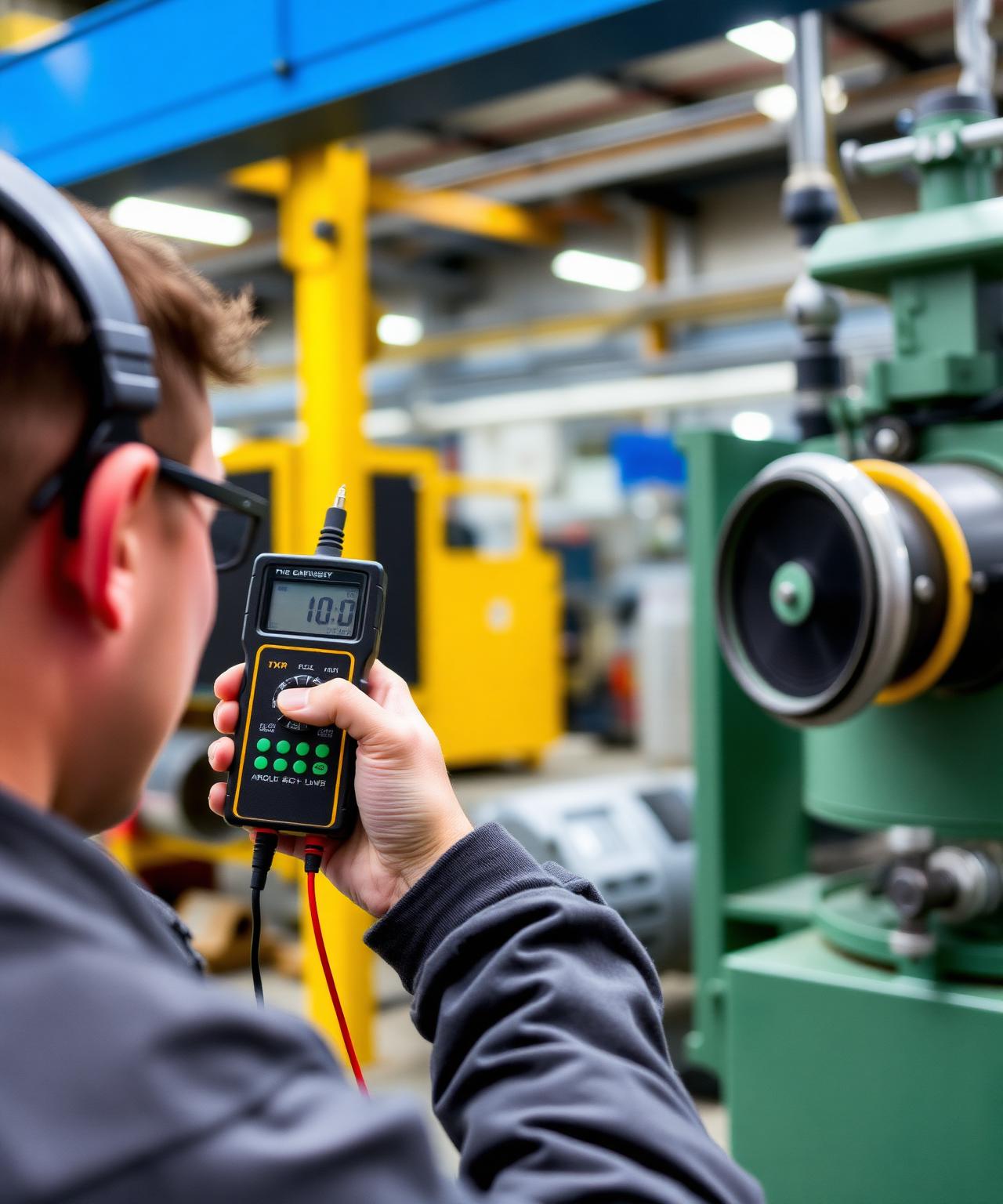
Sound pressure measurement
Class 1 · traceable
What it is
Sound testing as a focused measurement service
Workplace sound testing is the underlying measurement activity beneath every noise survey, every machine assessment, every control verification and every complaint investigation. Commissioning it on its own makes sense whenever the central question is a measurement question rather than a broader exposure or compliance question.
For the full exposure assessment, see noise exposure assessment and workplace noise surveys.
What is measured
Quantities reported
- LAeq (A-weighted time-averaged level)
- LCpeak (C-weighted peak)
- LCeq where C-weighting is needed
- LAFmax / LASmax
- Octave-band and 1/3-octave-band spectra
- Sound exposure level (SEL)
- Time history of level
Equipment
Instrumentation
- Class 1 integrating sound-level meters
- Class 1 acoustic calibrators
- Octave-band analysers
- Personal dosimeters where required
- Wind protection for outdoor work
- Tripod-mounted area logging
- Pre- and post-measurement calibration
Process
How sound testing is delivered
- 1
Define the question
We confirm exactly what decision the measurements need to support — exposure, machine verification, complaint or control check.
- 2
Measurement plan
Positions, durations, weightings and analysis bands defined to support that decision.
- 3
On-site measurement
Calibrated Class 1 measurement at the defined positions during representative operating conditions.
- 4
Analysis
Calculation of the relevant quantities, with documented assumptions and uncertainty.
- 5
Reporting
A short, decision-ready report including method, equipment, calibration and results.
Use cases
Typical use cases
- Verifying a single machine after modification
- Quantifying a single operator position
- Pre-checking before a full noise survey
- Verifying installed acoustic enclosure
- Investigating a complaint
- Comparing two equipment options
- Supplier data verification
- Cleaner shift or quieter task verification
Method
Quality assurance
- BS EN 61672 instrumentation
- Method aligned with BS EN ISO 9612
- Pre- and post-measurement calibration check
- Traceable equipment calibration
- Background-noise correction where required
- Operating-condition documentation
- Photographic record of positions
Deliverables
Reporting
- Method statement
- Equipment and calibration record
- Measurement results table
- Spectra where requested
- Operating conditions narrative
- Decision-focused conclusion
FAQ
Workplace sound testing — frequently asked questions
What is workplace sound testing?+
Workplace sound testing is the practical measurement of sound pressure level (SPL) in working environments — at machines, at operator positions and across work areas. It is the underlying measurement activity that supports exposure assessment, control evaluation, complaint investigation and hearing protection decisions.
How is it different from a noise survey?+
A noise survey is the wider assessment, including exposure calculation, control review and reporting. Sound testing is the underlying measurement work — sometimes commissioned on its own, for example to verify a specific machine, area or task.
What kind of equipment is used?+
Class 1 integrating sound-level meters (BS EN 61672), calibrated before and after each measurement set with a Class 1 acoustic calibrator. Octave-band and 1/3-octave-band analysis where the spectrum matters, and personal dosimeters where mobile exposure is the question.
What units are reported?+
Sound pressure level (dB), A-weighted and C-weighted where relevant; LAeq for time-averaged level over a measurement period; LCpeak for peak sound pressure; SEL where useful; and frequency-band results where spectral information is needed.
Is sound testing the same as acoustic testing?+
There is overlap but they are not identical. Sound testing focuses on sound pressure at people. Acoustic testing (covered separately) also evaluates reverberation, sound distribution, communication and room treatment — see workplace acoustic surveys.
When would I commission sound testing on its own?+
Common cases include verifying a single machine after a modification or control installation, investigating a single complaint, supporting a specific compliance question, or pre-checking an area before a larger survey.